
Point Cook Town Centre Growth: New Retail, Aldi Plan, Pop-Up Park Debate
Point Cook town centre growth is changing how residents shop, meet, and travel locally. New retail space, a proposed western supermarket hub, and a decision about a pedestrian street are the three issues shaping the suburb's next phase.
The practical question is whether future development can add convenience without losing accessible public places. This report explains what has opened, what is proposed, and what residents and traders should watch as decisions progress.
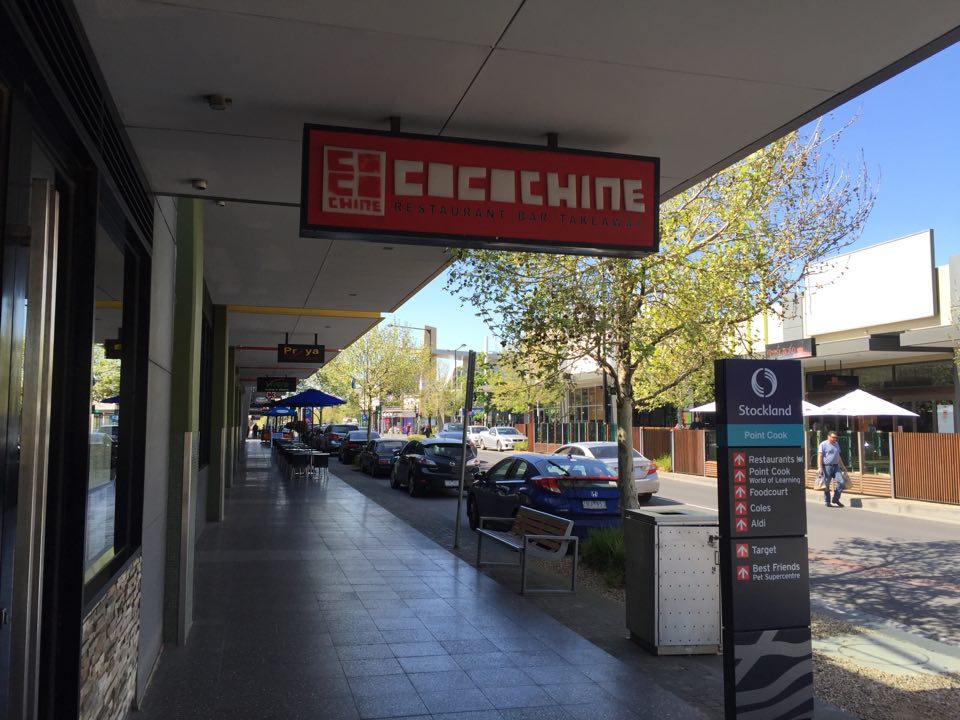
Point Cook Town Centre restaurants and cafes. Photo: Girod1970 via Wikimedia Commons, CC BY-SA 4.0. Image source: https://commons.wikimedia.org/wiki/File:Restaurants_in_Point_Cook,_Victoria.jpg
Stockland Point Cook Opens Point Social Precinct
A $25 million redevelopment at Stockland Point Cook concluded in late 2024 with the opening of Point Social, a refreshed dining and community precinct in the centre's Woolworths Quadrant. The project introduced Nando's, Schnitz, ShareTea, and East West Marketplace, with China Bar and Toro Sushi slated to follow. A book nook, children's play space for ages up to four, and flexible areas for work and gatherings now anchor the quadrant.
Centre Manager Dean Young said the precinct connects seamlessly to the Town Square and the Murnong Street pop-up park, which hosts the annual Kaleidoscope Festival. Public art by Jingwen (Jina) He and murals by Katherine Gailer and Lucy Lucy celebrate Point Cook's cultural diversity and the RAAF Base's aviation heritage. The grand opening weekend featured Father's Day workshops, live music, and a lion dance from East West Marketplace. Read the Stockland media release on Point Social.
The Point Social precinct represents a strategic shift toward experience-led retail. The dining precinct stretches along the main road, serving as the social heart of the community. Flexible spaces accommodate remote workers, students, and community groups. The children's play area, designed for ages up to four, addresses a gap in family-friendly infrastructure. The book nook provides a quiet retreat within a busy shopping environment. These elements combine to increase dwell time and visit frequency, key metrics for retail success in growth corridors.
The precinct design responds to how people use town centres today. Morning coffee routines, midday work sessions, afternoon family visits, and evening dining all occur in the same flexible footprint. Movable furniture allows reconfiguration for events, markets, and pop-ups. Power outlets and Wi-Fi support digital nomads and students. The play space uses inclusive design principles so children of all abilities can participate. This versatility makes the centre a daily destination rather than a weekly shopping stop.
The public art commission by Jingwen (Jina) He references Point Cook's coastal ecology and the RAAF Base's aviation legacy through abstracted forms and colour. Murals by Katherine Gailer and Lucy Lucy depict diverse community members in everyday moments. The annual Kaleidoscope Festival, now anchored at the Town Square, showcases music, dance, and food from the suburb's many cultural communities. This programming gives the centre a civic role alongside its retail function.
Aldi-Anchored Hub Proposed for Point Cook West
A new retail development at 421 Hacketts Road in Point Cook West advanced to Wyndham City Council's Planning Committee in February 2025. The $9.2 million proposal includes an Aldi supermarket as the main tenant, five food and drink premises, packaged liquor sales, and 98 on-site car spaces, eight fewer than the standard requirement. Council officers supported the reduction, citing strong pedestrian and cycling access plus multi-purpose trip patterns. See the WyndhamTV report on the Aldi proposal.
The site previously held a permit granted in April 2020 that lapsed without an extension. The new application was reviewed by Viva Energy due to proximity to an oil pipeline, with no objections raised. Because the proposal aligns with the Point Cook West Precinct Structure Plan, it was not subject to public advertising. The Planning Committee's decision was pending as of the February 11 meeting.
If approved, the development would complete a missing shared path link along Hacketts Road, improving walking and cycling connectivity. The supermarket's rear wall would cause minor overshadowing on a Buddaken Walk property, deemed acceptable by planners. The project would deliver the first dedicated supermarket to Point Cook West, a pocket that has relied on the main town centre for major grocery shopping.
The Point Cook West development addresses a clear service gap. The western pocket has grown rapidly since the last census, with new estates filling the corridor between Hacketts Road and the Princes Freeway. Residents currently drive to Stockland Point Cook or Williams Landing for full-line supermarkets. An Aldi at Hacketts Road would capture weekly grocery spend locally, support walkable neighbourhoods, and reduce vehicle kilometres travelled. The five food and drink premises would create a nascent dining node, potentially evolving into a second town centre anchor over time.
Aldi's entry into Point Cook West would intensify grocery competition in the Wyndham corridor. The German discounter's limited-assortment, private-label model appeals to price-conscious families, a demographic that dominates the growth corridor. Coles and Woolworths at Stockland Point Cook would face direct competition on weekly staple categories. Independent grocers in Williams Landing and Werribee would also feel pressure. The net effect for consumers is likely lower prices and more choice within shorter travel distances.
The development also signals a shift in the corridor's retail hierarchy. For over a decade, Stockland Point Cook has functioned as the single dominant centre. A second node at Hacketts Road would create a polycentric structure more resilient to disruption. If one centre experiences a major vacancy or construction disruption, the other maintains essential services. This redundancy is valuable in a fast-growing corridor where population growth outpaces infrastructure delivery.
Murnong Street Pop-Up Park: Community Asset or Traffic Bottleneck?
The most contentious issue centres on Murnong Street, where a section has been car-free since 2018. The pop-up park began as a temporary pilot inspired by Yarraville's Ballarat Street pedestrianisation but persisted through the pandemic years as public open space. It now hosts major events including SpringFest and Kaleidoscope, which CoLocal reports drew between 37,000 and 39,000 visitors combined, alongside Diwali celebrations and regular community use.
Stockland, the town centre developer, has indicated it wants the street reopened to vehicles. A company spokesperson said community engagement had declined after eight years, with minimal everyday use and falling event participation. Reopening the road, they argue, would improve trading conditions for small businesses while still allowing temporary activations.
Wyndham City Council, which owns the road, launched community consultation. Councillor Susan McIntyre, who helped establish the park, said it gave Point Cook a point of difference in a landscape of cookie-cutter greenfield developments. Federal MP Tim Watts, whose seat of Gellibrand covers most of Point Cook, urged residents to oppose the reopening in parliament. CoLocal founder Sara Mitchell called Stockland's characterisation of low usage "incredibly disingenuous," citing event attendance data. Read The Age investigation on the pop-up park debate.
Professor Kim Dovey, chair of architecture and urban design at the University of Melbourne, noted that as Melbourne densifies, reclaiming road space for public use becomes critical. He argued that if the park is not working, the solution is to make it work better rather than return it to cars.
The Age observed the precinct on a weekday afternoon and found tables filling with workers and students. Most interviewees favoured keeping the street closed. One restaurateur, speaking anonymously, countered that the park was empty in cooler months and prevented drive-by trade. Resident Josip Kutlesa supported reopening to ease congestion.
The debate reflects a broader tension in outer suburban town centres. Developers build pedestrian precincts as placemaking tools, then face pressure to maximise commercial yield through vehicle access. Councils own the roads but rely on developer funding for activation. Communities value the social infrastructure but may not organise effectively to defend it. The Murnong Street outcome will set a precedent for similar contests across Melbourne's growth corridors.
A careful assessment should look at more than vehicle counts. Council can compare pedestrian activity, trader feedback, delivery access, event attendance, and maintenance costs across different seasons. It can also test temporary changes before making a permanent decision. A winter market program, improved seating, weather protection, and a signed loading schedule would address several concerns without sacrificing the car-free layout. Publishing the method and results would give residents and traders a shared evidence base.
The decision also affects how people reach the centre. Families with prams, older residents, and people who cannot drive benefit from a calm, direct route between shops and public spaces. Traders need reliable deliveries, visible shopfronts, and easy customer access. Those objectives are not automatically opposed. A time-limited service lane, better wayfinding, and designated pick-up areas could support businesses while leaving the main pedestrian space intact. Wyndham's consultation should examine these design options before selecting a final street arrangement.
Population Growth Drives Retail Demand
Stockland's leasing data shows the main trade area population grew from 65,896 in 2011 to 116,994 in 2022, with a forecast of 124,994 by 2026 and 132,494 by 2031. The primary trade area alone is projected to reach 84,243 by 2026. Average household income in the primary trade area reaches $134,645, 16.3 percent above the Melbourne average. The median age of 33.3 years and high proportion of young families sustain demand for fresh food, dining, and family-oriented services. View the Stockland Point Cook leasing fact sheet.
The centre's 43,890 square metres of gross leasable area generates $295.55 million in moving annual turnover, with specialty sales at $7,941 per square metre. Annual traffic exceeds 9.46 million visits. Anchors include Target, Coles, Woolworths, Aldi, Dan Murphy's, and Rebel Sport, alongside six mini-majors and over 100 specialty stores.
The demographic profile is distinctive. Sixty point eight percent of households are couples with dependent children, well above the metropolitan average. The average age of 33.3 years is young for a major retail catchment. Household incomes exceed the Melbourne average by ten to sixteen percent depending on trade area ring. These factors drive high per-capita spend on groceries, children's services, dining out, and health and wellness. The three-supermarket model (Coles, Woolworths, Aldi) captures the full spectrum of grocery preferences and price points.
The tertiary trade area extends to 265,283 people by 2026, covering suburbs from Hoppers Crossing to Werribee and beyond. This wider catchment visits less frequently but for larger shops, entertainment, and specialty retail. The centre's location on the Princes Freeway makes it accessible from Geelong and the western districts. As the only three-supermarket centre in the corridor, it draws comparison shoppers from a wide radius.
Population growth also drives demand for health, education, and community services. The centre's commercial suites house medical centres, dental practices, and allied health providers. A co-located childcare centre operates at capacity with a waitlist. The adjacent Point Cook Town Centre medical precinct is expanding to include specialist consulting rooms. These services follow the retail anchor, creating a self-reinforcing cluster that reduces the need for residents to travel to central Melbourne for appointments.
What This Means for Residents
For Point Cook households, the changes bring more choice within walking or cycling distance. Point Social adds dining variety and indoor-outdoor community space. The potential Aldi in Point Cook West would cut travel time for western pocket residents. The pop-up park decision will shape whether the town centre prioritises pedestrian life or vehicle throughput.
Residents can engage through Wyndham City Council's consultation on Murnong Street. The council's planning portal provides updates on the Hacketts Road application. Stockland Point Cook's website lists upcoming events at the Town Square and Point Social. Residents and traders can make a useful submission by describing how they use the street, when they visit, and which access improvements would help. For local organisations seeking nearby customers, review the Point Cook directory before the next town centre change.
The immediate priorities are clear: confirm the Hacketts Road planning outcome, publish an evidence-based Murnong Street trial, and keep Point Social programming visible beyond opening celebrations. Residents should check opening hours before travelling, especially when visiting a new retailer or dining venue. Traders should track consultation notices and provide sales, delivery, and access evidence rather than relying only on general support or opposition. Those practical steps give council a stronger basis for balancing retail performance with the public life that makes a town centre useful.
Retail changes affect more than shopping trips. A nearby supermarket can make weekly errands easier for households without a second car. Food and drink premises can give local workers a place to meet without travelling across the municipality. A successful public space can provide free seating and informal gathering areas for residents who do not belong to a club or community facility. These benefits are difficult to capture in a simple turnover figure, but they influence whether people feel a new suburb has a genuine centre.
The next phase should therefore connect development decisions rather than treat them separately. The Hacketts Road path should link with existing walking and cycling routes. Point Social events should be promoted across the wider Wyndham community. Any Murnong Street trial should publish clear measures for trading, access, safety, and public use. Coordinating these steps would let residents judge the town centre as a complete network of shops, services, streets, and public places.
Explore Point Cook's Growing Suburbs
The Tarneit listing provides a comparison with another nearby growth area. The Williams Landing listing shows the next suburb in the local retail corridor. The Wyndham LGA category collects western growth corridor coverage. For related development reporting, see Romsey Hotel Revival: 8 Million Dollar Upgrade Plan.
Works Cited
Carey, Adam. "This pop-up park has 'brought the vibe' but could soon be ripped out." The Age, 30 Aug. 2025, www.theage.com.au/national/victoria/this-pop-up-park-has-brought-the-vibe-but-could-soon-be-ripped-out-20250828-p5mqj7.html.
Stockland. "New Point Social precinct opens at Stockland Point Cook." Stockland Media Centre, 2 Sept. 2024, www.stockland.com.au/media-centre/media-releases/new-point-social-precinct-opens-at-stockland-point-cook.
WyndhamTV. "New Supermarket and Retail Hub Proposed for Point Cook." WyndhamTV, 7 Feb. 2025, www.wyndhamtv.com.au/new-supermarket-and-retail-hub-proposed-for-point-cook/.
Stockland. "Point Cook Centre Overview." Stockland Leasing Fact Sheet, 2024, www.stockland.com.au/globalassets/retail-towncentres/vic/point-cook/home-page/leasing-fact-sheets_point-cook.pdf.